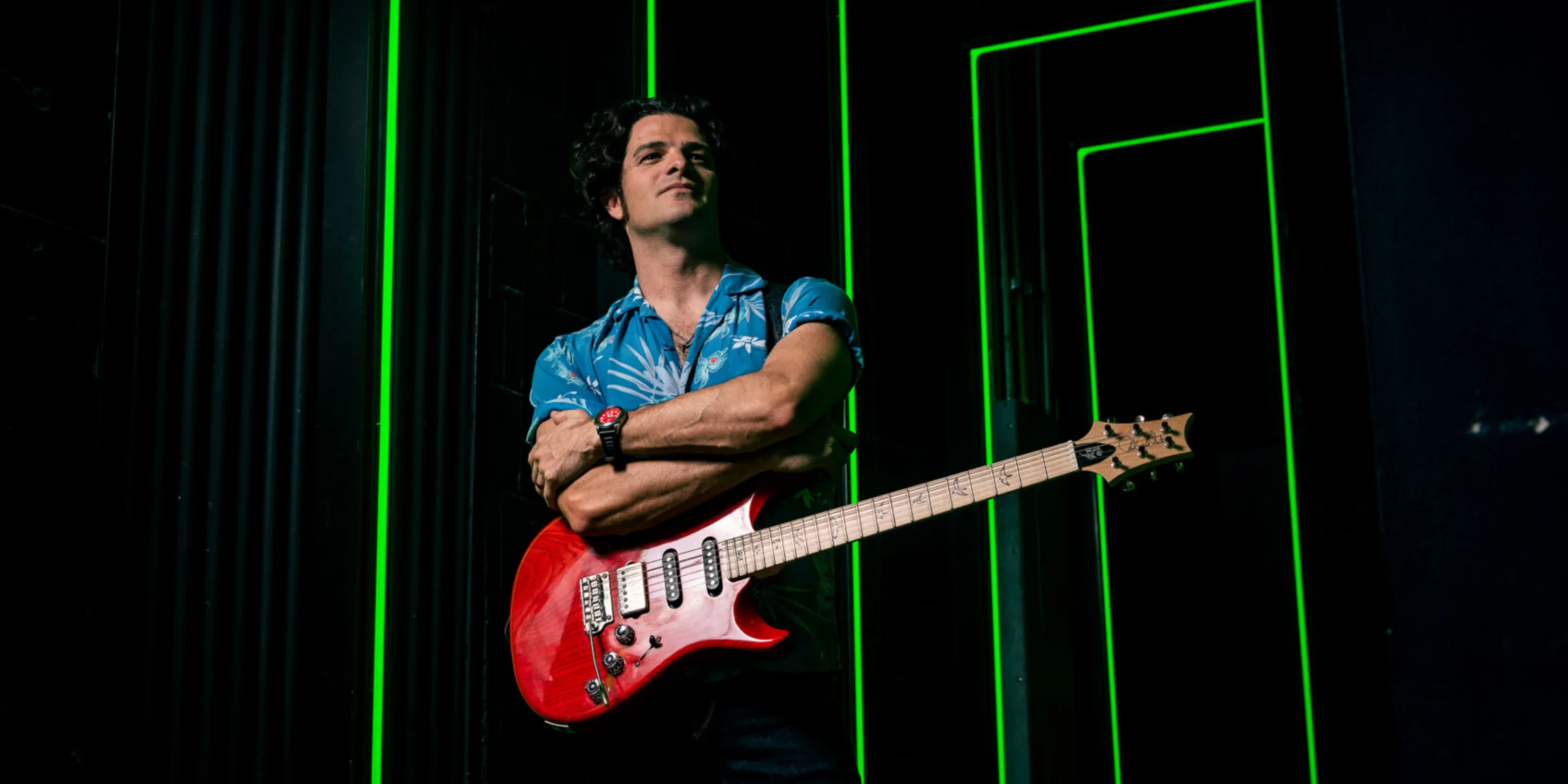
Unlike many guitarists on today's crowded stages, Mark Lettieri views his fretboard as a runway. Before he takes off, he makes sure every calibration, adjustment and screw is as it should be before he grabs a piece of sky. With Dragonfly, the riff-heavy opener of his latest album - Can I Tell You Something? - he makes good on this promise of flight. With Jason "JT" Thomas (drums), Daniel Porter (keys), Wes Stephenson (bass) and Bobby Sparks (organ) in the control tower, he has a dream team that lets him take off from the ground without the slightest worry of a malfunction. From the moment his landing gear leaves the runway, he soars with complete confidence.
Unlike many guitarists on today's crowded stages, Mark Lettieri views his fretboard as a runway. Before he takes off, he makes sure every calibration, adjustment and screw is as it should be before he grabs a piece of sky. With Dragonfly, the riff-heavy opener of his latest album - Can I Tell You Something? - he makes good on this promise of flight. With Jason "JT" Thomas (drums), Daniel Porter (keys), Wes Stephenson (bass) and Bobby Sparks (organ) in the control tower, he has a dream team that lets him take off from the ground without the slightest worry of a malfunction. From the moment his landing gear leaves the runway, he soars with complete confidence.
Canyon Run maintains the flyover feeling. This aerodynamic rocker eats forward motion for breakfast and doesn't let up until the last spoonful. Like the entire set, it holds its course towards the future without forgetting the past. Lettieri is a genius performer and songwriter, and his bandmates understand how the slightest change in wind direction can affect the entire flight. Their vision takes Blankworld, a highlight for its vivid imagination, to another level. Fiery yet cool (like so much of Lettieri's work), it's a fearless act of skywriting.
Though some tracks exceed the six-minute mark, including the dynamic slow-dive "Black Iris" (with added shreds from violinist Zach Brock) and the rich "Shimmy Tiger," there's not a single wasted note, solo or arrangement. The latter is also a bridge between two albums that are essentially one. While the first half explores the more anthemic side of the coin, Saturday Stuff polishes the other with a focus on groove, followed by Greenspace, a mysteriously bluesy spell on autopilot. Neural Net is one of two funk-outs for the baritone guitar, a proven navigational tool in the captain's arsenal, anticipating every moment of turbulence with style. This dichotomy is at the heart of Can I Tell You Something?, whose title reflects Lettieri's desire to express the breadth of his compositional palette.
While the 80s vibes lean more towards the Prince and Jeff Beck bands of the influence spectrum, Cyndi Lauper gets her due in a lush version of Time After Time. Despite (or perhaps because of) the artful restraint and sparkling acoustic accents, none of the power is lost here, as the passionate climax proves. Even the album's finale, Gemstone, embraces the magic of pop sensibility. It is a delicate and precious piece, shimmering with love and major-key bliss.
Lettieri's tone is more vibrant than ever, with just enough acidity to keep us from thinking we've heard it all before. His confidence is free of pretension - a balance that is increasingly difficult to find in the guitar world. He's becoming more flexible with time, and this is his most acrobatic release yet. And when he throws the trapeze handle in our direction, it's up to us to wrap our ears around it and trust that we'll make it to the other side.
We use cookies and analysis tools. This is how we ensure that our website looks and works well. Detailed information can be found in the
privacy policy.